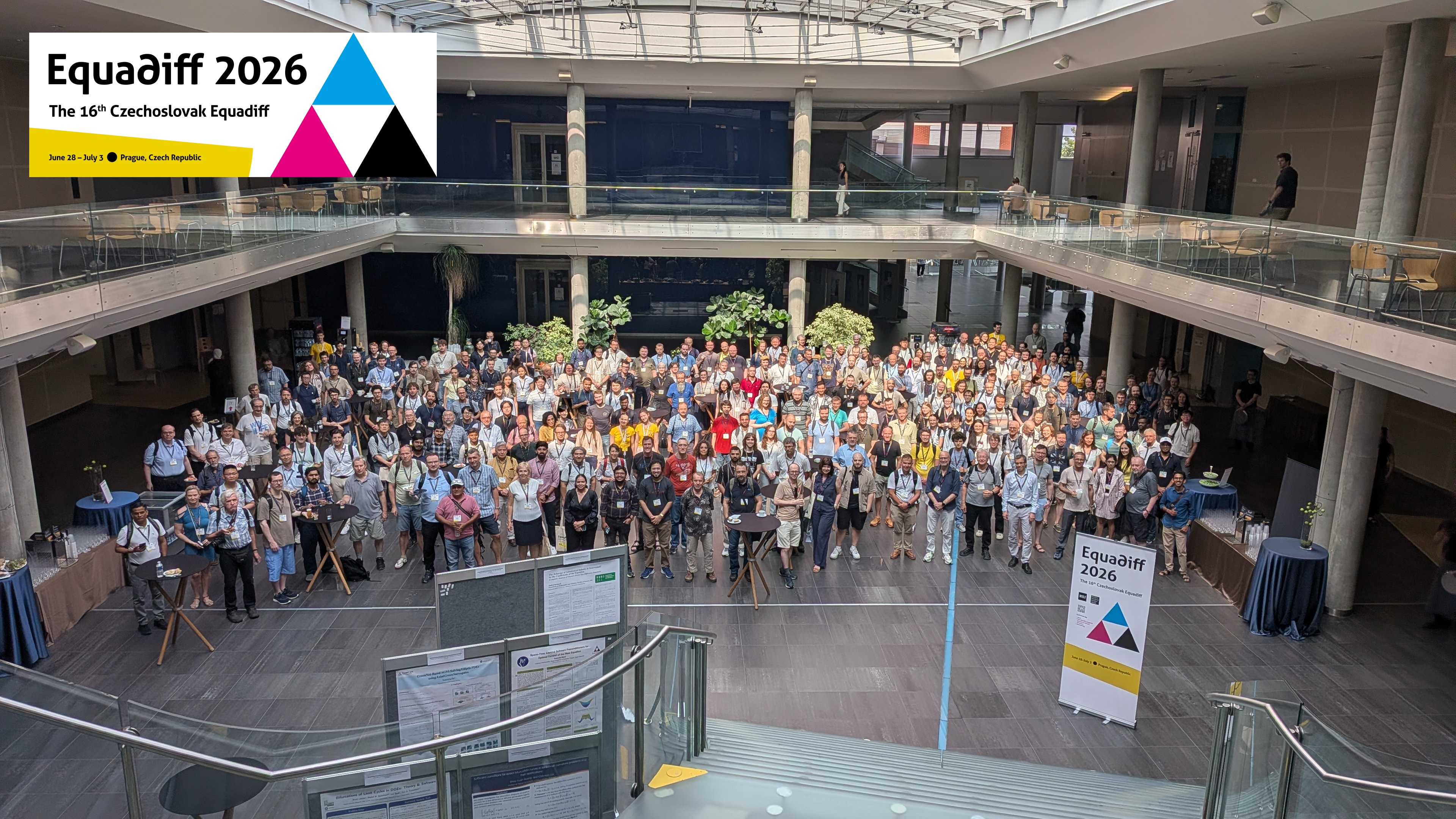
Welcome to Equadiff 2026, the latest in a series of biennial European conferences on differential equations and their applications.
The tradition of the Czechoslovak Equadiff dates back to 1962 when Equadiff 1, organized by, among others, Ivo Babuška and Jaroslav Kurzweil, took place in Prague. Subsequent Czechoslovak Equadiff conferences rotated between Bratislava, Brno, and Prague every four years except for a few irregularities, the last caused by the COVID pandemic. The Western Equadiff conferences originated in Marseille (France) in 1970 and have been held in various European countries (Austria, Belgium, Germany, Greece, Italy, Netherlands, Portugal, Spain, Sweden, and the United Kingdom) since then. They also adopted a four-year period and, together with the Czechoslovak Equadiff, have formed a biennial series. The upcoming Equadiff in Prague in summer 2026 will be the 16th conference within the Czechoslovak Equadiff series. This tradition makes Equadiff the oldest series of conferences on the topic, and we are proud to continue it.
The conference will be devoted to the fields of ordinary differential equations, partial differential equations, as well as numerical analysis and applications. These topics will be covered by plenary and invited lectures, minisymposia, contributed talks, and posters. To taste what the Equadiff conferences offer, please visit the websites of Equadiff 2024 in Karlstad, Equadiff 15 in Brno, or the Czech Digital Mathematics Library, where all the Czechoslovak Equadiff proceedings are freely available.
Plenary speakers

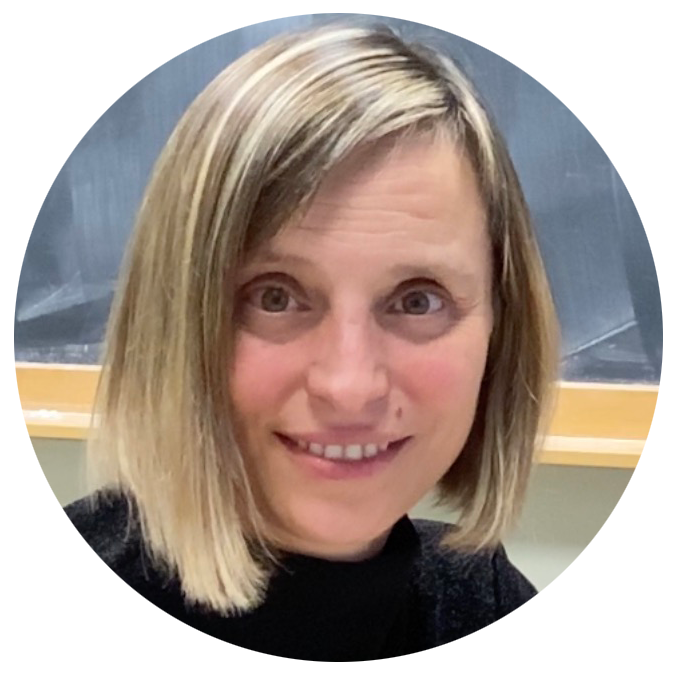
Paola F. Antonietti
MOX - Laboratory for Modeling and Scientific Computing, Department of Mathematics, Politecnico di Milano, Italy
Title:
Modeling Human Brain Function and Pathways of Neurodegeneration

Jan Bouwe van den Berg
Department of Mathematics, Vrije Universiteit Amsterdam, The Netherlands
Title:
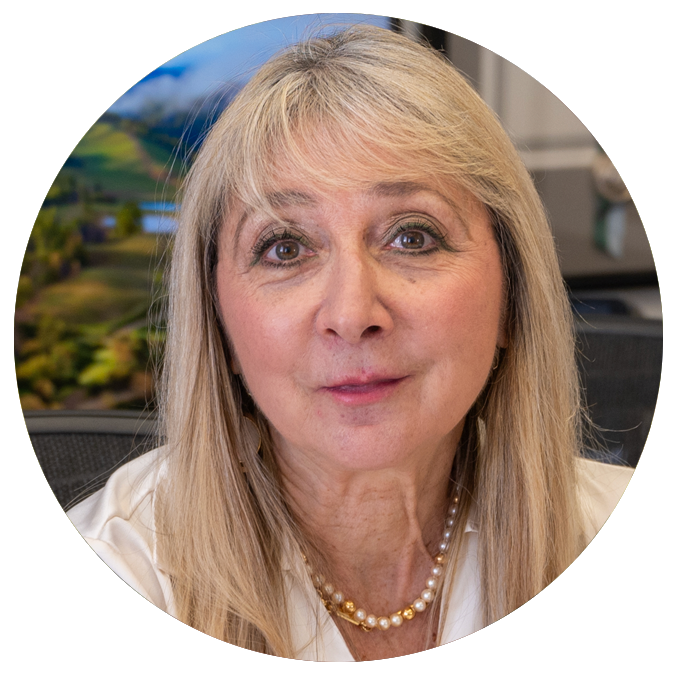
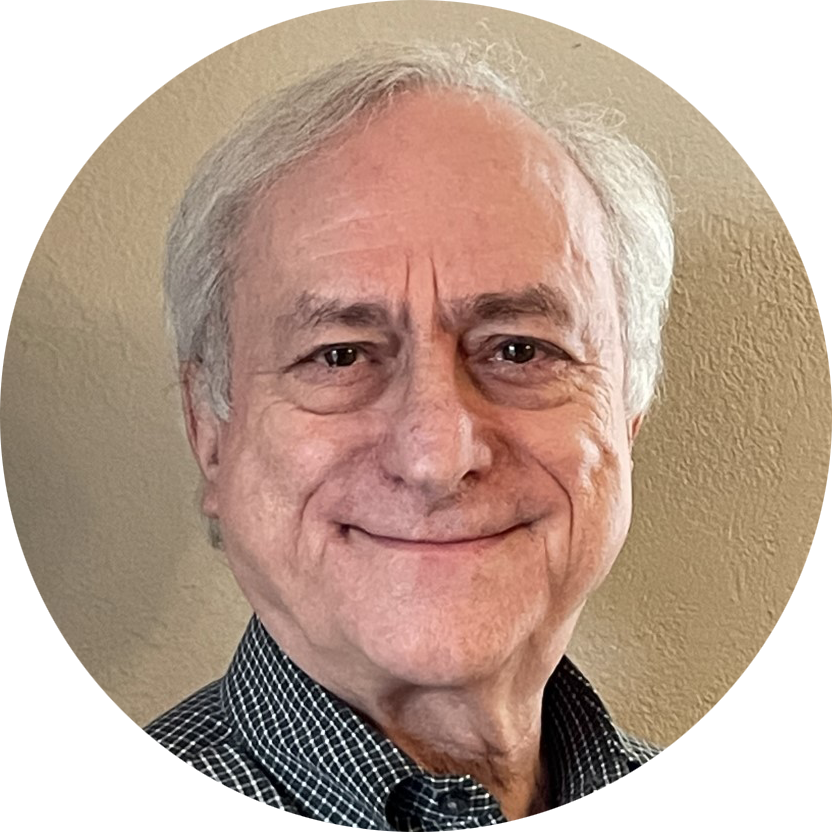
Irene Fonseca
Department of Mathematical Sciences, Carnegie Mellon University Pittsburgh, USA
Title:
Oscillations and Concentrations in the Calculus of Variations

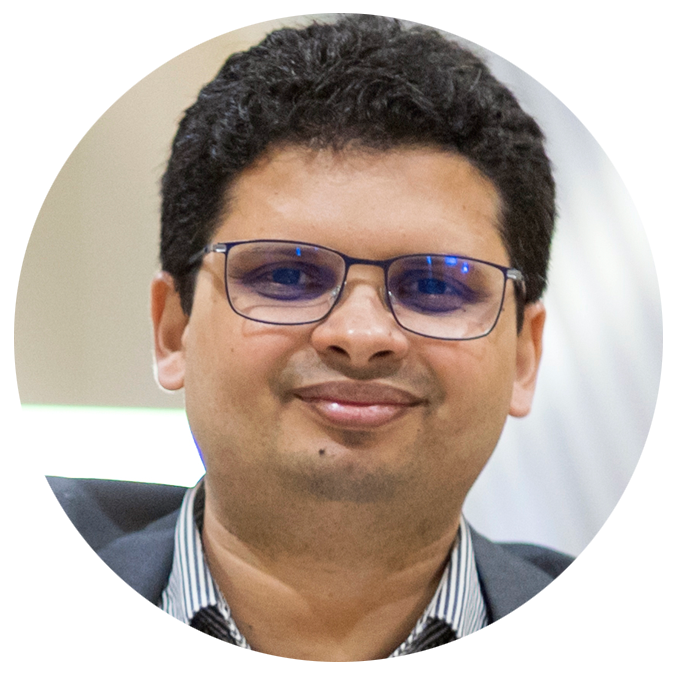
Siddhartha Mishra
Seminar for Applied Mathematics (SAM), D-MATH and ETH AI Center, ETH Zurich, Switzerland
Title:
AI for PDEs

Rafael Ortega
Departamento de Matemática Aplicada, Facultad de Ciencias Universidad de Granada, Spain
Title:

Angkana Rüland
University of Bonn, Institute for Applied Mathematics, Bonn, Germany
Title:
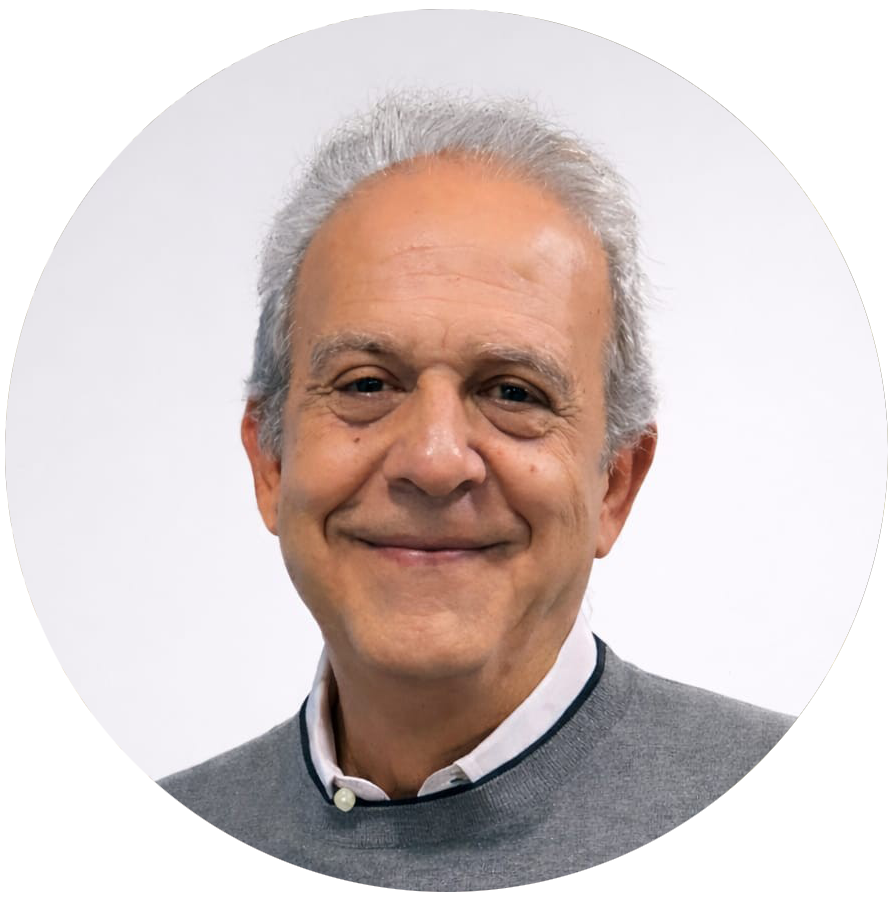
Paola F. Antonietti
Presentation title:
Modeling Human Brain Function and Pathways of Neurodegeneration
Affiliation:
MOX - Laboratory for Modeling and Scientific Computing, Department of Mathematics, Politecnico di Milano, Milano, Italy
Short bio:
Professor Paola F. Antonietti is Head of the Laboratory of Modeling and Scientific Computing MOX and Full Professor of Numerical Analysis at Politecnico di Milano. Her research centers on advanced (polytopal) numerical methods and computational learning techniques for the approximate solution of partial differential equations, with applications across various fields including computational neuroscience, engineering seismology, and subsurface flow simulations. Paola Antonietti has authored two books and over one hundred publications in international journals. She actively participates in many national and international research initiatives, as well as scientific advisory and editorial boards. In recognition of her significant contributions to applied mathematics and computational science, she received the 2016 SIMAI prize from the Italian Society of Applied and Industrial Mathematics and the 2020 Jacques-Louis Lions Award from ECCOMAS—the European Community on Computational Methods in Applied Sciences. She is the recipient of a 2023 ERC Synergy Grant, funded by the European Union.

Jan Bouwe van den Berg
Presentation title:
A spectral approach to computer-assisted proofs in dynamics
Affiliation:
Department of Mathematics, Vrije Universiteit Amsterdam, The Netherlands
Short bio:
Jan Bouwe van den Berg is a professor of mathematics at the Vrije Universiteit Amsterdam. His research focuses on the dynamics of patterns described by differential equations. In particular, he applies topological, variational, and computational techniques to study the behaviour of nonlinear dynamical systems. In recent years, his work has centred on computer-assisted proof methods to rigorously validate numerical simulations of solutions to ordinary, partial, and delay differential equations that model patterns in materials and fluid flows.

Irene Fonseca
Presentation title:
Oscillations and Concentrations in the Calculus of Variations
Affiliation:
Department of Mathematical Sciences, Carnegie Mellon University Pittsburgh, USA
Short bio:
Irene Fonseca is the Kavčić-Moura University Professor of Mathematics at the Department of Mathematical Sciences at Carnegie Mellon University, where she is the Director of the Center for Nonlinear Analysis (CNA).
Irene Fonseca’s main contributions have been on the variational study of ferroelectric and magnetic materials, composites, thin structures, phase transitions, and on the mathematical analysis of image segmentation, denoising, detexturing, registration and recolorization in computer vision. Her research program continues to explore modern methods in the calculus of variations motivated by problems issuing from materials science and imaging science.
She is a Fellow of the American Mathematical Society (AMS), a Fellow of the Society for Industrial and Applied Mathematics (SIAM), a Fellow of the European Academy of Sciences, and she was elected to the Academy of Sciences of Lisbon (Portugal). She was SIAM President in 2013 and 2014. She is a Grand Officer of the Military Order of Saint James of the Sword (Grande Oficial da Ordem Militar de Sant’Iago da Espada, Portuguese Decoration). She is Vice-President of the American Mathematical Society from 2023 till 2026. She serves in 21 Editorial Boards, including Advances in Calculus of Variations, Archive for Rational Mechanics and Analysis, Communications of the AMS (CAMS), ESAIM:COCV (SMAI), Journal of Nonlinear Science, Mathematical Models and Methods in Applied Sciences (M3AS), and SIAM Journal on Mathematical Analysis. She is a member of several advisory and scientific boards of research centers and institutes, she participates in international prize committees, and is in review and evaluation panels of multiple universities in the US and abroad.
Fonseca has supervised 18 Ph.D. students and mentored 45 postdoctoral fellows.

Siddhartha Mishra
Affiliation:
Seminar for Applied Mathematics (SAM), D-MATH and ETH AI Center, ETH Zurich, Raemistrasse 101, Zurich, Switzerland.
Presentation Title:
AI for PDEs.
Short Bio:
Siddhartha Mishra is a chair Professor of Applied Mathematics at ETH Zurich, where he heads the Computational and Applied Mathematics Laboratory (CAMLab). He is also the Director of Computational Science Zurich and a core faculty member of the ETH AI Center. His research interests lie in the fields of numerical analysis, scientific computing and machine learning with applications to different fields of science and engineering including fluid dynamics, astrophyiscs, climate science, geophysics and biology. He is an elected Fellow of the European Academy of Sciences and a recipient of the Collatz Prize of ICIAM, the Dahlquist Prize of SIAM and von Mises Prize of GAMM, among others. He is also an invited speaker at the International Congress of Mathematicians (ICM) in Rio in 2018.

Rafael Ortega
Presentation title:
A periodic prey-predator system
Affiliation:
Departamento de Matemática Aplicada Facultad de Ciencias, Universidad de Granada, Spain
Short bio:
Ph D 1984
Professor at Universidad de Granada
Research work in Differential Equations and Mechanics
Some topics: periodic solutions, stability, twist maps, perturbations of Kepler problem,
population models with seasonal effects

Angkana Rüland
Presentation title:
On (In-)Stability Mechanisms in Inverse Problems
Affiliation:
University of Bonn, Institute for Applied Mathematics, Bonn, Germany
Short bio:
Angkana Rüland studied mathematics at the University of Bonn and the MPI MIS in Leipzig. She received her PhD from the University of Bonn in 2014. After a postdoc position at the University of Oxford and a research group leader position at the MPI MIS in Leipzig she became full professor at the University of Heidelberg in 2020. In 2023 she returned to the University of Bonn where she holds a Hausdorff Chair. Central research interests are inverse problems and phase transition problems in solid-solid phase transitions.
Invited speakers

Bjoern Bringmann
Princeton University, Department of Mathematics, Princeton, USA
Title:
On the global well-posedness of singular SPDEs

Guglielmo Feltrin
Università degli Studi di Udine, Dipartimento di Scienze Matematiche, Informatiche e Fisiche (DMIF), Udine, Italy
Title:

Martin J. Gander
University of Geneva, Section of Mathematics, Geneva, Switzerland
Title:
Preliminary: What is new in domain decomposition?

Tomas Gedeon
Department of Mathematical Sciences, Montana State University, Bozeman, USA
Title:
Continuous and discrete time dynamics of regulatory networks
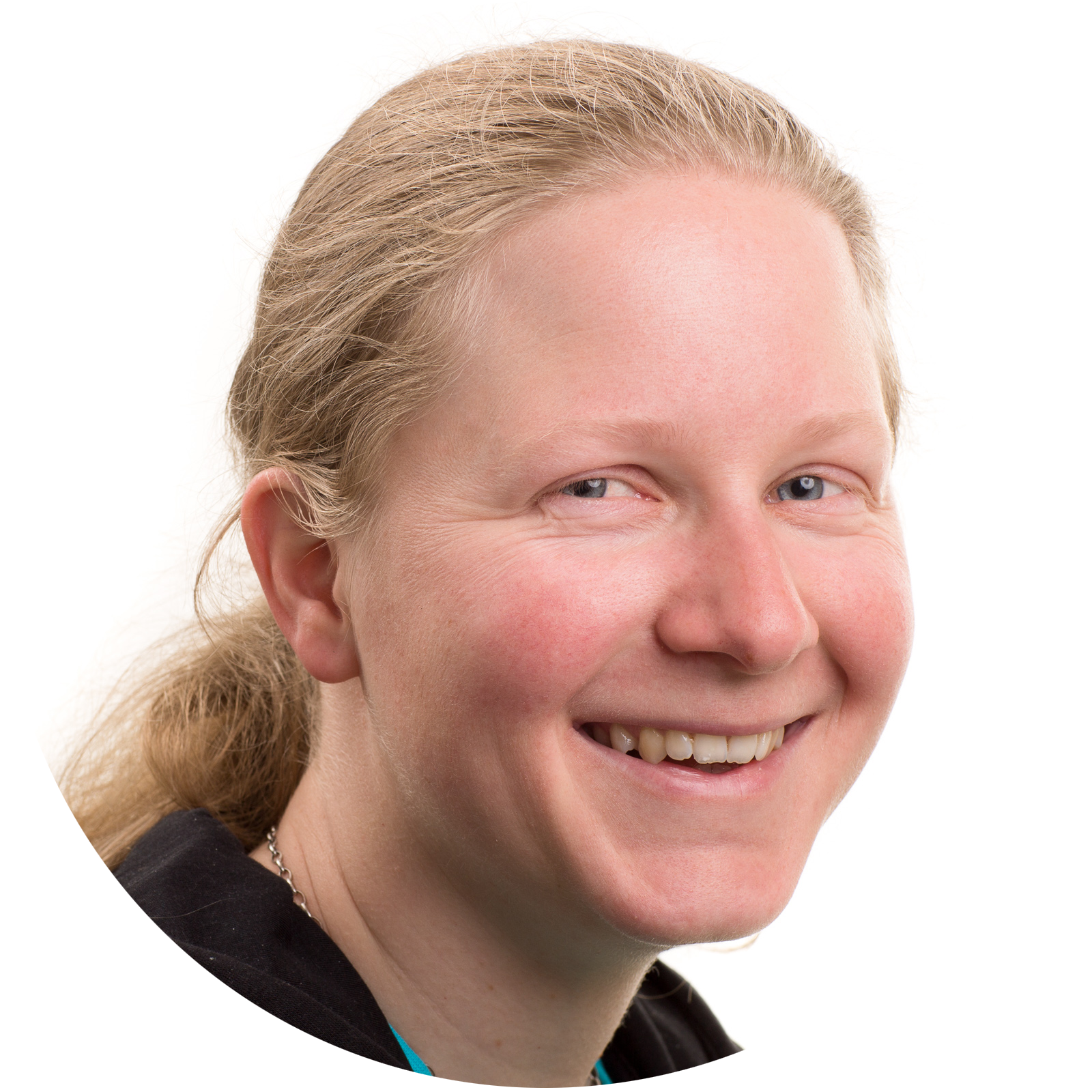
Jonathan Jaquette
New Jersey Institute of Technology
Department of Mathematical Sciences, New Jersey, USA
Title:
Applications of computer-assisted proofs in delay differential equations

Miho Murata
Shizuoka University, Department of Mathematical and Systems Engineering, Hamamatsu-shi, Shizuoka, Japan
Title:
Global solvability of the Q-tensor model for nematic liquid crystals
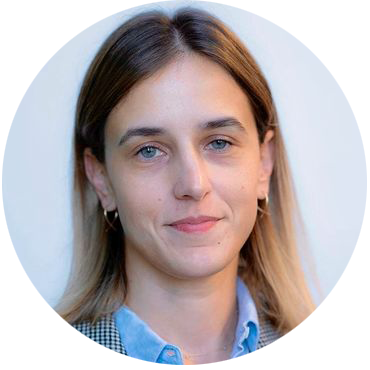
Hirokazu Saito
Graduate School of Informatics and Engineering, The University of Electro-Communications, Tokyo, Japan
Title:
On the dispersive effect of internal gravity waves in two-phase incompressible viscous flows

Martin Vohralík
Project-team SERENA, Inria, Paris, France
Title:
Potential and flux reconstructions for optimal a priori and a posteriori error estimates
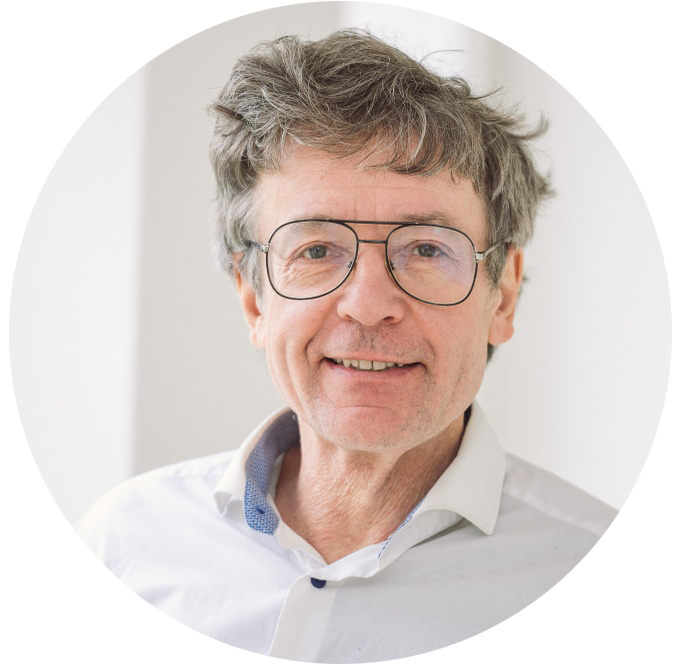
Bjoern Bringmann
Presentation title:
On the global well-posedness of singular SPDEs
Affiliation:
Princeton University, Department of Mathematics, Princeton, NJ 08540, United States
Short bio:
Bjoern Bringmann’s research interests lie at the interface of partial differential equations and probability theory. More specifically, he has worked on random dispersive equations and singular parabolic SPDEs. Since 2024, he has been an Assistant Professor in the Department of Mathematics at Princeton University. Before that, he was a Postdoctoral Research Associate at Princeton University and a Member of the Institute for Advanced Study. He obtained his Ph.D. in 2021 from the University of California, Los Angeles, where he was advised by Terence Tao.

Guglielmo FELTRIN
Presentation title (preliminary):
Exploring the relativistic Kepler problem: A journey through bounded orbits and bifurcation phenomena
Affiliation:
Università degli Studi di Udine, Dipartimento di Scienze Matematiche, Informatiche e Fisiche (DMIF), Udine, Italy
Short bio:
Guglielmo Feltrin is an Associate Professor at the University of Udine, in Italy. He received his Ph.D. in Mathematical Analysis from the International School for Advanced Studies (SISSA) in Trieste, under the supervision of Professor Fabio Zanolin. Following his Ph.D., Professor Feltrin held postdoctoral positions at the University of Mons (Belgium) and at the University of Turin (Italy). He then joined the Polytechnic University of Turin as a researcher. He was later appointed to a tenure-track researcher position at the University of Udine, where he has been serving as an Associate Professor since 2022.
Professor Feltrin's research is primarily focused on Differential Equations, Dynamical Systems, and Nonlinear Analysis, with a particular emphasis on qualitative properties of the solutions and topological methods such as fixed point theory and degree theory, a field in which he has developed considerable expertise since his doctoral studies. In recent years, he has expanded his research interests to include problems from Celestial Mechanics and perturbed Hamiltonian systems, collaborating closely with the University of Turin. He is also a member of the DEG1 Differential Equations Group of North-East, an Italian network of mathematicians affiliated with universities in the Friuli Venezia-Giulia region.

Martin J. Gander
Presentation title:
Preliminary: What is new in domain decomposition?
Affiliation:
University of Geneva, Section of Mathematics, Geneva, Switzerland
Short bio:
Martin J. Gander is a professor of mathematics at the University of Geneva and was previously a professor of mathematics at McGill University. He has held many visiting professor positions, including the Jean Morlet Chair of the CIRM in fall 2022 and the FSMP Chair in Paris in 2023. He became a SIAM Fellow in 2020. His research interests are numerical analysis and scientific computing, numerical linear algebra and parallel computing, iterative methods and preconditioning, and time parallel time integration.

Tomas Gedeon
Presentation title:
Continuous and discrete time dynamics of regulatory networks
Affiliation:
Department of Mathematical Sciences, Montana State University, Bozeman, MT, USA.
Short bio:
I received B.S. and M.Sc. from Comenius University in Bratislava, Slovakia 1989, followed by PhD in Mathematics from Georgia Tech, USA 1994.
I am interested in dynamical systems including ODEs, DDEs, PDEs and discrete time Boolean models in the context of modeling complex real-world systems.
In the last 10 years these applications mostly involve systems biology, in particular models of gene regulatory networks and metabolite exchanging microbial consortia.
A particular mathematical interest is a connection between Boolean discrete time models and ODE models of gene regulatory networks.

Jonathan Jaquette
Presentation title:
Applications of computer-assisted proofs in delay differential equations
Affiliation:
New Jersey Institute of Technology, Department of Mathematical Sciences, Newark, New Jersey, USA
Short bio:
Short bio incl. scientific interests.
Jonathan Jaquette is an assistant professor in the Department of Mathematical Sciences at the New Jersey Institute of Technology. His research broadly focuses on nonlinear dynamics, with an emphasis on computer-assisted proofs and infinite dimensional systems such as PDEs and DDEs. In his PhD thesis he proved Wright's conjecture (1955) and Jones Conjecture (1962).

Miho Murata
Presentation title:
Global solvability of the Q-tensor model for nematic liquid crystals
Affiliation:
Shizuoka University, Department of Mathematical and Systems Engineering, Hamamatsu-shi, Shizuoka, Japan
Short bio:
Miho Murata is an associate professor at Shizuoka University, JAPAN.
She is interested in the well-posedness for quasilinear problems of parabolic type or parabolic-hyperbolic type appearing in fluid dynamics in unbounded domains. Her motivation is to construct a unique strong solution in the maximal regularity class.
Recent topic is the local and global well-posedness for the Q-tensor model describing the nematic liquid crystal flow.

Hirokazu Saito
Presentation title:
On the dispersive effect of internal gravity waves in two-phase incompressible viscous flows
Affiliation:
Graduate School of Informatics and Engineering, The University of Electro-Communications, Tokyo, Japan
Short bio:
My scientific interests include free boundary problems for the one-phase and two-phase Navier–Stokes equations, and the decay properties of the semigroups associated with these equations.
Selected publications:
- H. Saito and X. Zhang, On the dispersive effect of internal gravity waves for the two-phase Stokes semigroup, submitted.
- H. Saito, On the asymptotic stability for the two-phase Navier–Stokes equations with surface tension and gravity, to appear in Math. Ann.
- H. Saito and Y. Shibata, Global solvability for viscous free surface flows of infinite depth in three and higher dimensions, Nonlinear Anal. 264 (2026), Paper No. 113985, 58 pp.
- K. Oishi and H. Saito, Global solvability for a two-phase problem of inhomogeneous incompressible viscous fluids, Calc. Var. Partial Differential Equations 64 (2025), no. 9, Paper No. 289, 95 pp.
- H. Saito, Decay properties of the Stokes semigroup for two-phase incompressible viscous flows, Dissertationes Math. 598 (2024), 74 pp.

Martin Vohralík
Presentation title:
Potential and flux reconstructions for optimal a priori and a posteriori error estimates
Affiliation:
Project-team SERENA, Inria, Paris, France
Short bio:
Martin Vohralík is a Czech scientist working as a Senior researcher at Inria Paris, France. He is the head of the project-team SERENA; he also holds a Professor degree of the Charles University in Prague. Previously, he was an Associate professor at the Sorbonne University in Paris, France. He serves as an Editor of Computational Geosciences, Applications of Mathematics, and Acta Polytechnica journals. He held the ERC consolidator grant GATIPOR in 2015–2021. His research interests include partial differential equations, numerical discretization methods, numerical linear algebra; and scientific computing, with a specific interest in a posteriori error control and adaptivity. He works on applications to flows and transport in porous media.
ODE:
Numerical analysis and applications: